Stillform Practice
Let the buildings lead.

- Sector / Year
- Architecture
2025 - My role
- Content modelling and frontend development
- Scope
- Project archive, project pages, practice profile, and image credits
- Built with
- Statamic · Antlers · CSS
The brief
Stillform Practice works on houses, small public spaces, and the reuse of existing buildings. Each project needs enough room for its particular story, but the archive also needs to work as a whole. A visitor should be able to scan the practice’s interests without reading every description.
The starting point was a consistent set of project facts: location, building type, status, year, and collaborators. Those facts support the archive and give each individual page a dependable introduction.
Build the archive before the individual page
I treated the project index as a useful overview of the practice. Image proportions vary within a controlled grid, while the title and essential facts remain predictable. Visitors can narrow the selection by building type without losing their place.
A project can change from ongoing to completed without requiring a new page or a rewritten archive entry. Its structured information supplies both views.
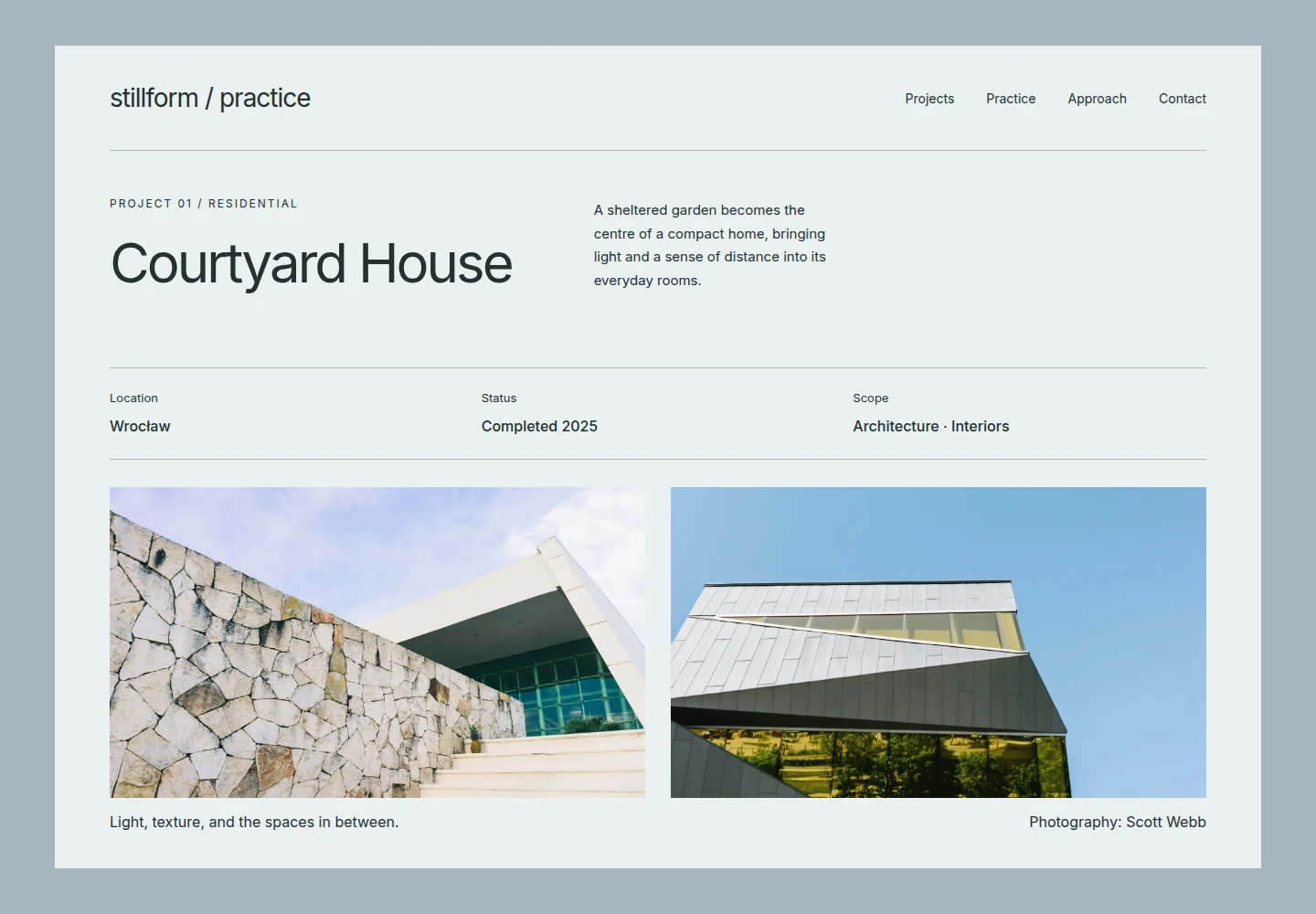
Give photography a clear role
Large photographs establish the building’s character. Smaller details then explain materials, thresholds, and relationships between spaces. Captions carry information that would otherwise be lost in a sequence of attractive images.
Credits travel with the image records, so they do not have to be reconstructed at the end of a page. Related projects are chosen deliberately to connect similar questions about space or use.
The editing experience
The practice enters project facts once, selects a cover, and builds the story from text and image groups. A separate summary supports the archive. This prevents a long opening paragraph from becoming an awkward card description.
The image fields ask for captions and credits alongside the upload. Making those details part of the ordinary editing task helps keep the archive consistent as it grows.
What this project brings together
The content model gives different projects a shared framework without forcing identical stories. The tradeoff is intentional: editors can vary the sequence of images and text, while the key facts retain a fixed position.